

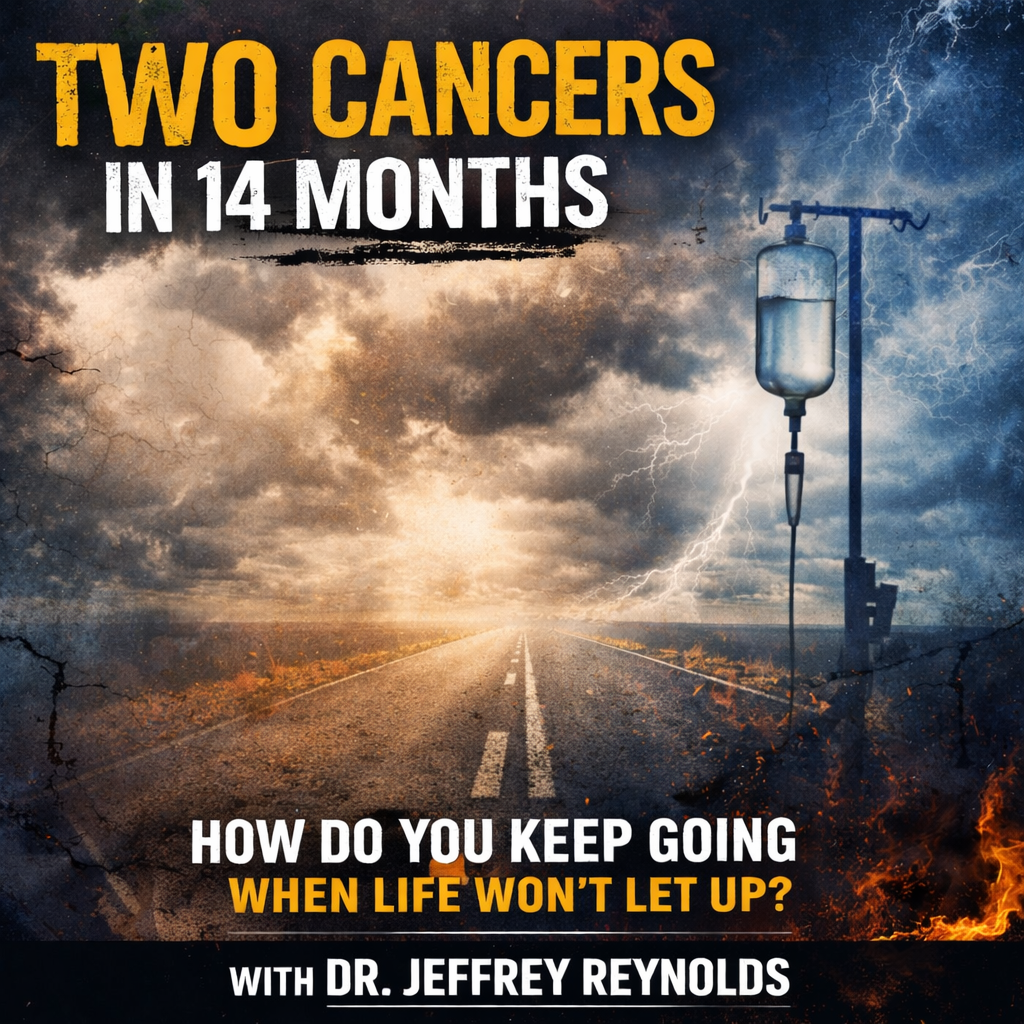
What do you do when life will not let up?
That question sits at the center of one of the most powerful recent conversations on Overcome With Travis White. In this episode, Travis sits down with Dr. Jeffrey Reynolds, an author, nonprofit executive, Ironman triathlete, husband, father, and two-time cancer survivor, to talk about what it really looks like to keep going when one life-altering diagnosis is followed by another.
This is not a conversation built on cliches. It is not about pretending everything happens for a reason. It is not about forcing positivity when life feels terrifying. Instead, it is an honest discussion about fear, mental strength, uncertainty, vulnerability, faith, discipline, and the kind of resilience that gets built when life gives you no easy option but to keep moving.
Dr. Reynolds shares what it was like to receive a cancer diagnosis in the middle of a normal day, how he navigated two cancers in just 14 months, and what helped him keep showing up for his family, his work, and his own mental health in the middle of deep uncertainty. If you are exhausted, overwhelmed, or trying to carry more than feels fair, this conversation will meet you there.
When life changes in an instant
One of the hardest parts of adversity is how quickly everything can change.
In this episode, Dr. Jeffrey Reynolds describes getting life-changing news in a way that no one would ever choose. One moment, life looked normal. The next, he was staring at a diagnosis that would divide life into before and after. That sudden shift is something many people understand, even if their pain looks different. It could be a health diagnosis. A traumatic loss. A mental health collapse. A marriage falling apart. Losing a job. Getting a phone call that changes everything.
The moment itself is often only the beginning.
What follows is the emotional aftershock. Fear. Confusion. The pressure to keep functioning while your inner world is unraveling. The realization that even if everyone around you means well, they cannot fully understand what it feels like to carry the uncertainty in your own body.
That is why this episode matters so much. It gives language to the experience of being hit by something you did not ask for and did not deserve, and then having to somehow keep living anyway.
Two cancers in 14 months and the mental toll of uncertainty
There is already so much emotional weight in one diagnosis. Facing two cancers in 14 months is a level of adversity that most people can barely imagine.
What stands out in this conversation is not just the severity of what Dr. Reynolds endured. It is the mental reality of living in between appointments, scans, treatment decisions, side effects, and unknowns. So often, people talk about illness in terms of the medical facts, but the emotional burden can be just as intense. The waiting. The anticipatory anxiety. The thoughts that creep in when the room gets quiet. The constant awareness that your life has become fragile in a way it did not feel before.
That uncertainty can break a person down emotionally.
It can also isolate them.
One of the truths that comes through strongly in this episode is that encouragement can be complicated. People often say things like, “You’ll be okay,” because they want to help. But when someone is staring down something serious, those words can feel hollow. Sometimes what a person needs most is not reassurance. Sometimes they need honesty, presence, and space to admit that this is hard.
That honesty is one of the strengths of this conversation. It does not simplify the emotional reality of serious adversity. It allows it to be real.
The difference between toughness and true resilience
For more stories about mental strength after adversity, visit the Resilience hub.
For another perspective on resilience after a major setback, read about building an unstoppable mindset.
A lot of people have been taught to believe that being strong means hiding emotion.
They think resilience means never falling apart, never admitting fear, never showing weakness. But that version of strength is exhausting, and for many people, it is unsustainable. In this episode, Travis and Dr. Reynolds get into the tension between a warrior mentality and vulnerability. That is such an important part of the conversation because many listeners, especially men, have been conditioned to believe they must perform strength at all times.
Real resilience is not denial.
Real resilience is staying engaged with life while telling the truth about what you are carrying.
That might mean admitting you are afraid. It might mean asking for support. It might mean crying, questioning, praying, venting, journaling, walking, training, resting, or simply getting through one day at a time. It might mean continuing to show up without pretending you are untouched by what is happening.
This episode is a reminder that vulnerability is not the opposite of strength. Often, it is the deepest form of strength available.
How endurance training shaped his mindset in crisis
One of the most compelling parts of this conversation is how Dr. Reynolds drew from his background as an Ironman triathlete during his cancer journey. Before the diagnoses, he had already spent years doing hard things. Long training days. Physical exhaustion. Discomfort. Mental battles. The discipline required to keep moving when the body wants to quit.
That did not make cancer easy. But it gave him a framework.
It gave him a language for endurance.
It gave him a history of proving to himself that he could keep going through pain, uncertainty, and discomfort.
There is something powerful in that lesson, even for people who are not athletes. We all have places in our lives where we have developed endurance. Sometimes it comes from grief. Sometimes from surviving childhood trauma. Sometimes from parenting through chaos. Sometimes from rebuilding after addiction, anxiety, burnout, or failure. The point is not that pain is good. The point is that pain often teaches us something about what we are capable of carrying.
Dr. Reynolds shows that the mental side of endurance matters. Training the mind to stay present in discomfort can become an asset when life gets brutal. It does not erase fear, but it can strengthen your ability to face it.
The anxiety that follows treatment
For related mental health recovery stories, explore the Mental Health hub.
A lot of conversations focus on diagnosis and treatment, but not enough talk about what comes after.
What happens when the treatment ends, but the anxiety does not?
What happens when people assume you should feel grateful and relieved, but part of you is still bracing for the next bad thing?
This episode touches on the anxiety that comes with ongoing scans, follow-ups, and the fear of recurrence. That kind of fear can be difficult to explain to people who have not lived it. From the outside, someone may look fine. They may be working, smiling, training, parenting, or functioning normally. But internally, they are carrying a new awareness of mortality.
That does something to a person.
It can deepen gratitude, yes. But it can also create tension, hypervigilance, and a complicated relationship with the future. You want to move forward, but part of you is always looking over your shoulder.
That emotional truth makes this conversation so valuable. It gives listeners permission to acknowledge that surviving something does not mean you instantly feel at peace. Healing is rarely that clean.
Faith, mortality, and the questions adversity brings up
For another perspective on how faith can shape recovery, read about how to rebuild your life after loss.
Adversity has a way of forcing deeper questions to the surface.
What matters now?
What do I believe?
Who am I when the life I counted on no longer feels secure?
This conversation explores faith and spiritual wrestling in a way that feels human rather than polished. Serious suffering often pushes people into questions they cannot ignore. It challenges assumptions. It strips away shallow answers. It can also make someone more aware of what truly matters.
In Dr. Reynolds’ story, adversity sharpened his awareness of time, purpose, and legacy. That is one of the hidden tensions in hardship. Pain can take a lot from you, but it can also reveal what is most essential.
That does not make the suffering worth it.
It does mean suffering can leave a person changed.
For some, that change leads to more gratitude. More intention. More honesty. More willingness to stop wasting time on things that do not matter. For others, it begins with questions. Either way, this episode gives space for the deeper inner work that often follows major life disruption.
What this episode teaches about supporting someone in crisis
One of the most practical takeaways from this conversation is how we support people who are suffering.
Many people want to help, but they do not know what to say. So they reach for quick reassurance. They try to fix. They try to brighten the mood. They say things they hope will comfort, but sometimes those words land as distance rather than care.
This episode offers a better path.
Supporting someone through a major diagnosis or life crisis often looks like listening more than talking. It looks like resisting the urge to force hope. It looks like being steady, present, and honest. It looks like letting someone be scared without trying to rush them out of it.
That applies well beyond cancer.
It applies to grief, trauma, burnout, depression, anxiety, addiction recovery, and any season where a person is carrying more than they know how to hold. People do not always need the perfect words. Often they need to feel less alone.
Why this conversation will stay with listeners
There are some podcast episodes that inform you, and there are others that stay with you.
This is one of the ones that stays with you.
It stays with you because it is honest. Because it does not reduce resilience to slogans. Because it shows what strength can look like when life becomes relentless. Because it speaks to the part of people that is tired from carrying one hard thing after another.
Dr. Jeffrey Reynolds’ story is extreme in its details, but universal in its emotional truth. Most people will not face the exact same circumstances. But many people know what it feels like to ask, “How much more can I take?” Many know what it feels like to keep functioning while feeling worn down inside. Many know what it is like to need a reason to keep going.
This episode does not offer easy answers.
It offers something better: perspective, honesty, and a picture of resilience that feels real.
If life has been relentless lately, this conversation is worth your time.
If you have been trying to stay strong while quietly carrying fear, this conversation is worth your time.
If you need a reminder that pain can deepen purpose without erasing pain itself, this conversation is worth your time.
Sometimes the most powerful thing we can hear is that someone else has walked through the unthinkable and kept going. Not perfectly. Not painlessly. But honestly.
And sometimes that is enough to help us take the next step too.
What we discussed in this episode
- Receiving a cancer diagnosis via phone notification
- Facing two cancers in 14 months
- Managing anxiety between medical scans
- The warrior mentality versus vulnerability
- Why “You’ll be okay” is not always helpful
- Faith, mortality, and spiritual wrestling
- Using endurance sports as mental training
- How exercise protects mental health during crisis
- Supporting someone through a major health diagnosis
- Turning adversity into purpose and legacy