

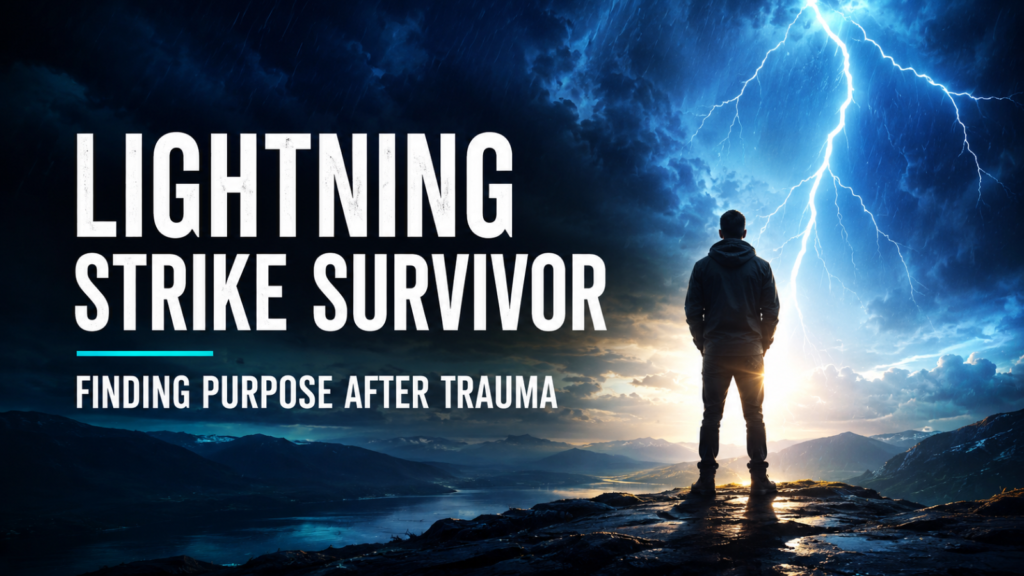
Lightning Strike Survivor Justin Briggs: Fear, Purpose, and Rebuilding After Trauma
Some stories divide life into before and after. For lightning strike survivor Justin Briggs, that divide came during a summer storm while he was working as a backpacking guide. One moment he was in the field with participants and staff. The next, lightning had surged through his body, seized his muscles, and left him on the ground unable to move.
In this episode of Overcome with Travis White, Justin talks with Travis about the strike, the fear that followed, the way his family shaped his healing, and how purpose can grow out of a chapter no one would ever choose. The conversation is not a polished success speech. It is a grounded story about trauma, resilience, parenting, identity, and the slow work of rebuilding a life after everything changes.
What We Discussed
- What Justin remembers from the lightning strike and the minutes immediately after
- How fear can linger long after the danger has passed
- Why family became one of his strongest reasons to keep moving forward
- The role of small victories, consistency, and mindset in rebuilding after trauma
- How Justin thinks about purpose, writing, coaching, and helping other people face fear
- Why mental health struggles deserve the same empathy people often give physical pain
The Moment Everything Changed
Justin describes the lightning strike as the most transformative event he has experienced. It happened about a week after his youngest daughter was born, while his wife was just coming out of the hospital and their family had a newborn at home. That timing matters. This was not only a physical crisis. It landed in the middle of a deeply human season filled with responsibility, love, exhaustion, and a new life waiting for him at home.
In the episode, Justin says he stayed conscious during the strike. What shocked him most was not only the flash, the sound, or the force of it, but the inability to move afterward. He remembers being on the ground with his body seized up. He could move his head, but not the rest of himself. He was in hail and could not feel the cold the way he expected to. He knew he was alive, but he also knew something serious had happened.
That kind of moment can change the way a person understands safety. It can make the world feel less predictable. It can put fear into the body before the mind has enough words for it. Justin’s story is powerful because he does not flatten that experience into a quick lesson. He lets it be what it was: frightening, disorienting, and life-altering.
Fear Does Not Always Leave When the Crisis Ends
One of the deeper themes in this conversation is fear. The strike itself ended quickly, but the impact did not. Justin talks about how an event like that can shape the way you move through the world afterward. Fear can become tied to weather, to the body, to uncertainty, and to the awareness that life can change without asking permission.
That is true for many forms of trauma. The original event may be over, but the nervous system can keep responding as if danger is close. The mind can replay what happened. The body can brace. Ordinary moments can start to carry extra weight. Healing often means learning how to live with that awareness without letting it control every decision.
This is where Justin’s story connects with so many listeners, even if they have never experienced a lightning strike. Fear has many forms. It can come after an accident, a diagnosis, a loss, a panic attack, a betrayal, a public failure, or a season that left someone wondering whether life would ever feel steady again.
Justin does not present fear as something you simply defeat once and never feel again. Instead, the conversation points toward a more honest kind of courage: learning how to keep living, loving, creating, and serving while fear is still part of the story.
Family Gave the Healing a Deeper Why
Throughout the episode, Justin’s family is never far from the center of the story. The strike happened right after his daughter was born, and he speaks about his wife and kids with a clear sense of gratitude. He talks about wanting to be present for them, watching his children grow, and seeing the different stages of parenting as something meaningful rather than something to simply survive.
That perspective matters because resilience is easier to talk about in the abstract than it is to live out at home. Healing is not only about personal strength. It is also about the people who give you a reason to keep going. It is about the moments you still want to be here for. It is about the relationships that remind you your life is bigger than the fear you are carrying.
For Justin, family did not erase the trauma. But it gave the healing weight and direction. It helped him keep looking forward.
Small Victories Can Rebuild Confidence
Near the end of the conversation, Justin shares an idea that feels simple but lands deeply: things can get better, and they can keep getting better. He talks about not being limited by circumstances, and about paying attention to small victories and small successes because they build over time.
That is one of the most useful parts of this episode for anyone trying to rebuild after a hard season. When life has been overwhelming, a huge transformation can feel impossible. But small victories are different. They are closer. They are honest. They help a person rebuild trust with themselves one choice at a time.
A small victory might be making the call, taking the walk, apologizing, writing the page, showing up for the appointment, asking for help, or simply getting through the day without giving up on yourself. Those moments may not look dramatic from the outside, but they can become the structure of a new life.
That same theme shows up in Overcome’s article on self-awareness and resilience, where growth begins with honest reflection and steady choices rather than instant change.
Purpose Can Grow From Pain Without Pretending Pain Was Good
Justin’s story also raises an important question: what do you do with a life-changing event after it happens?
He has written, coached, and thought deeply about helping people remove blocks, face fear, find passion, and pursue a more meaningful life. In the episode, he talks about creative work, including his books, and the hope that his ideas can reach people in a bigger way. He also talks about learning to act on ideas instead of dismissing them too quickly.
There is a careful distinction here. Turning pain into purpose does not mean the pain was good. It does not mean trauma was necessary. It does not mean every hard thing needs to be wrapped in a lesson before it is allowed to hurt.
Purpose is something different. Purpose is what a person builds with what remains. It is the decision to use a story, a scar, a lesson, or a survival chapter in a way that helps someone else feel less alone. Justin’s story does that. It gives language to fear and also points toward movement.
For another conversation about rebuilding meaning after adversity, the episode on finding purpose and daily success habits pairs naturally with Justin’s message.
Mental Health Struggles Deserve Real Empathy
One of the strongest reflections Justin offers is about the difference between how people often respond to physical health struggles and mental health struggles. He notes that when someone has a visible physical limitation, people may understand more quickly that daily life is harder. But when someone names a mental health struggle, that same understanding is not always automatic.
That point deserves attention. A person can look functional and still be carrying anxiety, depression, trauma, grief, panic, or fear that makes ordinary life feel exhausting. A person can show up, work, parent, smile, and still be fighting an internal battle no one else can see.
Justin says he hopes for more understanding and acceptance around mental health, the kind where people recognize that some days really are hard to function. That kind of empathy is part of the mission behind Overcome. These conversations help make invisible pain more speakable.
If mental health has been heavy lately, support matters. A trusted friend, therapist, doctor, pastor, support group, or crisis resource can help you carry what should not be carried alone. Asking for help is not weakness. It is one of the ways people stay connected to life.
What Justin Briggs’ Story Offers the Person Who Feels Stuck
The hope in this episode is not loud or fake. It is steady. Justin’s story says that fear may be real, but it does not have to be the only voice in the room. Trauma may change you, but it does not have to write the rest of your life without your participation. Small steps may feel unimpressive, but they still count. Purpose may take time to recognize, but it can still grow.
That message matters for anyone who feels stuck after a hard chapter. Maybe your story is not a lightning strike. Maybe it is anxiety, grief, illness, burnout, betrayal, parenting stress, addiction recovery, depression, or the private exhaustion of trying to be okay when you are not. Whatever the shape of it, you are allowed to take healing one honest step at a time.
Justin’s life is not proof that everything becomes easy. It is a reminder that people can survive the unthinkable and still find ways to love, create, help, parent, and move forward.
Listen to the Full Episode
To hear Justin tell the story in his own words, listen to the full conversation with Travis White. The episode includes more of the details from the lightning strike, his reflections on family, his creative work, and the mindset he hopes will help others keep going.
Listen to the Full Episode Explore More Overcome Stories