

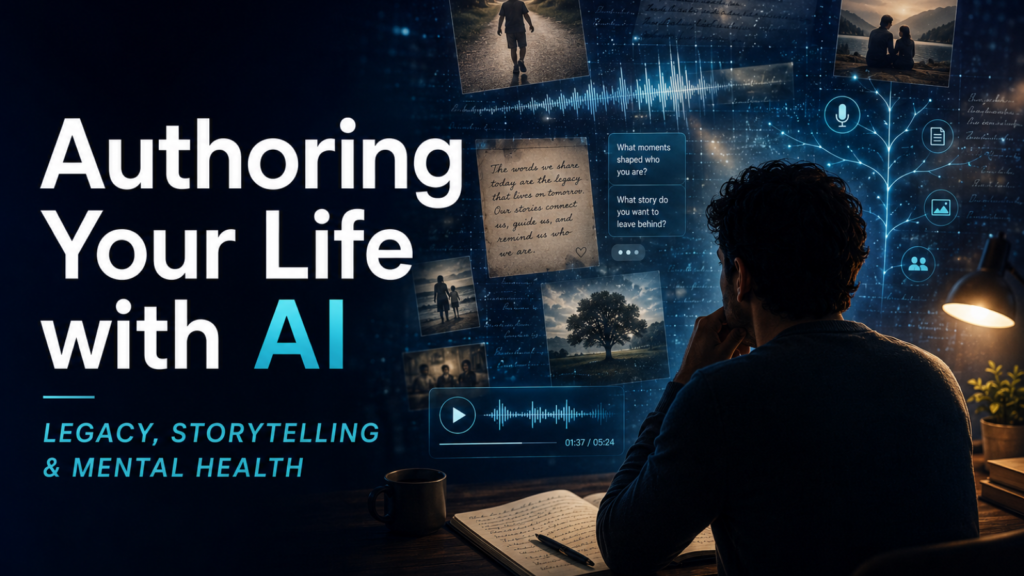
Authoring Your Life With AI: Legacy, Storytelling, and Mental Health
Everyone has a story. Not just the polished version people see online, and not just the hard chapters we wish we could skip. A real life story includes the family we came from, the beliefs we inherited, the obstacles that shaped us, the losses we carried, the questions we kept asking, and the moments that taught us who we were becoming.
In this episode of Overcome with Travis White, Travis talks with Cristian Cibils Bernardes, founder and CEO of Autograph, about authoring your life with AI. Their conversation explores how artificial intelligence can help people preserve memories, capture family stories, reflect on mental health, and see their own lives through a more meaningful lens.
This is not a conversation about replacing human connection. It is about using technology to ask better questions, remember what matters, and give people a way to tell stories that might otherwise disappear.
What We Discussed
- Cristian’s upbringing in Paraguay and the entrepreneurial lessons he learned from his parents
- How Stanford, Google, and his personal story shaped the creation of Autograph
- Why authoring your life with AI can help preserve family legacy and personal memory
- How guided storytelling can make reflection feel easier than a blank page
- Why reframing hardship as part of a larger story can support resilience
- The emotional power and ethical weight of preserving a loved one’s voice and story
- How mental health stigma is tied to shame, projection, and our relationship with our own minds
Why Authoring Your Life With AI Matters
Authoring your life with AI sounds futuristic, but the need behind it is very old. People want to be remembered. Families want to hold onto the voices, stories, lessons, and values of the people they love. Many of us wish we had asked more questions before someone was gone.
Cristian explains Autograph as a tool built around that human need. Instead of asking someone to sit in front of a blank page and write a full autobiography from scratch, the platform uses an AI interviewer named Walter to guide the conversation. The person answers questions. The story begins to take shape. Over time, memories, patterns, and meaning become easier to see.
That matters because storytelling is not only about the past. It can help people understand the present. It can bring shape to difficult seasons. It can turn scattered memories into something that feels held instead of lost.
For many people, reflection is hard because the blank page feels too big. Travis shares in the episode that prompts can make it easier to begin. That is a meaningful insight for anyone who has tried journaling for mental health and then stalled because they did not know what to write. Sometimes the right question is what opens the door.
From Paraguay to Stanford, Google, and Autograph
Cristian’s story begins in Paraguay, where he grew up in a close family culture and watched his parents build technology businesses with grit and persistence. Both of his parents were computer scientists and entrepreneurs. He saw, up close, what it looked like to keep trying when ideas failed, plans changed, and the future was uncertain.
That early environment shaped how he thinks about resilience. He did not describe success as a straight line. He talked about adaptation, problem solving, and the way family history can influence how you see your own path.
Later, his journey took him to Stanford and Google, and eventually to founding Autograph. The through-line is not just technology. It is the desire to help people understand themselves and preserve what makes a life meaningful.
That is where this episode connects so naturally with the heart of Overcome. The show is built around real mental health stories, honest growth, and the belief that people are more than their hardest chapter. Cristian’s work approaches that same idea through the lens of memory, AI, and legacy.
Storytelling Can Help Reframe Hardship
One of the strongest ideas in the conversation is that we can learn to see life as a story. That does not mean pretending pain is good or forcing every struggle into a neat lesson. It means recognizing that hardship does not have to be the whole identity. It can be one chapter in a larger arc.
Cristian talks about people going through a kind of hero’s journey, whether they frame it that way or not. That idea matters for mental health because shame often tells a smaller story. Shame says, “This is all you are.” A fuller story says, “This happened, it affected you, and there is still more to who you are becoming.”
This is similar to the kind of perspective Travis explores in the FAITH Framework, especially the work of understanding your foundation, identity, and hope. When someone can name what they have been through without being completely defined by it, healing has more room to breathe.
Authoring your life with AI may support that process by helping people revisit memories with structure. A thoughtful prompt can bring forward the experiences that shaped your values, the people who influenced you, the losses that changed you, and the moments where you kept going even when life was heavy.
Legacy Is More Than Information
It is easy to think of legacy as facts: names, dates, jobs, places, and milestones. But the deeper parts of legacy are emotional. What did someone believe? What did they overcome? What did their voice sound like when they told a story? What did they want their children or grandchildren to understand?
Cristian’s work with Autograph points toward that deeper kind of preservation. The episode touches on the possibility of capturing not only information, but tone, memory, personality, and voice. That is powerful, and it also asks people to be thoughtful. These tools deserve care because memory is intimate.
Used responsibly, AI storytelling can become a bridge. It can help families hear stories they never knew. It can help people preserve a parent’s wisdom, a grandparent’s voice, or their own reflections for future generations. It can also help someone notice the meaning in their life while they are still living it.
That last part may be the most important. Autograph is not only about what people leave behind. In Cristian’s words, it is also about the future: the chance to rediscover who you are, why you are here, and what effect you can have on the people around you.
Mental Health, Shame, and the Stories We Avoid
The conversation also turns directly toward mental health stigma. Cristian offers a thoughtful perspective: sometimes stigma is not only about the person who is struggling. It can also reflect the discomfort other people feel about their own minds, their own shame, and what they would fear if they were in that person’s position.
That is a compassionate and challenging idea. It suggests that stigma often grows where people are afraid to empathize. If someone else’s pain reminds us of what we do not want to feel, we may distance ourselves instead of listening.
This is why storytelling matters so much in mental health. Stories make suffering harder to flatten. They remind us that a person is not a diagnosis, a symptom, a failure, or a worst moment. A person is a whole life in motion.
For readers who are trying to understand therapy, support, and mental health more clearly, the article Mental Health Therapy Explained is a helpful companion. Professional support can be an important part of healing, especially when someone is dealing with depression, anxiety, trauma, crisis, or patterns that feel too heavy to carry alone.
How AI Prompts Can Support Reflection
A blank page can be intimidating. So can a direct question like, “Tell me your life story.” Most people do not know where to begin. AI-guided storytelling can lower that barrier by giving people a question, then another, then another.
That kind of structure can be useful because many people process better through conversation than through uninterrupted writing. Cristian points out that people may get writer’s block, but they rarely get stuck in the same way when they are talking through a prompt with someone, or something, that keeps the conversation moving.
For mental health, the benefit is not that AI replaces a therapist or a trusted person. It does not. The benefit is that guided reflection may help people notice patterns, articulate memories, and begin telling the truth about their lives. It can be a starting point for deeper conversations with family, friends, mentors, or mental health professionals.
That distinction matters. Technology can support reflection, but human care still matters. If your story includes trauma, suicidal thoughts, abuse, addiction, or overwhelming distress, it is worth reaching for qualified help and immediate support where needed. You deserve more than a tool. You deserve care.
What This Episode Can Teach Us About Resilience
Cristian’s story is not only about AI. It is also about the resilience that forms when someone watches people keep trying, learns from difficulty, and chooses to build something meaningful from their own experiences.
Resilience is not pretending life was easy. It is being able to look back honestly and say, “This shaped me.” It is being able to see the thread between where you came from and what you are building now.
That is why authoring your life with AI can become more than a novelty. When used well, it can invite people to pause long enough to see their own strength. It can remind them that their story includes more than pain. It includes effort, love, memory, growth, and possibility.
Overcome has explored similar themes in conversations about living with Bipolar II and recurring depression, the hidden mental load of parenting, and rebuilding trust after difficult moments. Different stories, same deeper invitation: be honest about what happened, then keep building from there.
Questions to Help You Start Authoring Your Own Story
You do not need an AI tool to begin reflecting on your life, though tools can help. You can start with a few honest questions:
- What is one story from my family that I do not want to lose?
- What hardship shaped me more than I realized at the time?
- Who helped me become more resilient?
- What belief did I inherit that I want to keep?
- What belief did I inherit that I need to question?
- What do I want future generations to understand about my life?
- Where have I been reducing my story to one painful chapter?
These questions are not about creating a perfect memoir. They are about paying attention. They are about noticing the parts of your story that deserve care before they fade into the background.
Listen to the Full Episode
If this conversation stirred something in you, listen to the full episode of Overcome with Travis White. Cristian explains the vision behind Autograph, how AI can help preserve legacy, why guided storytelling matters, and what mental health stigma reveals about shame and empathy.
Listen to the Full Episode Explore More Overcome Stories
Final Thoughts
Authoring your life with AI is really a conversation about memory, meaning, and identity. It asks what happens when technology helps us tell the stories we might otherwise avoid, forget, or leave unfinished.
Cristian Cibils Bernardes reminds us that every person has a story worth preserving. Not because every life is easy, but because every life carries lessons, relationships, turning points, and quiet moments of resilience.
If you are in a hard chapter right now, your story is not over. You are not only what happened to you. You are also the person still here, still reflecting, still learning, and still capable of building something meaningful from the life you have lived.