

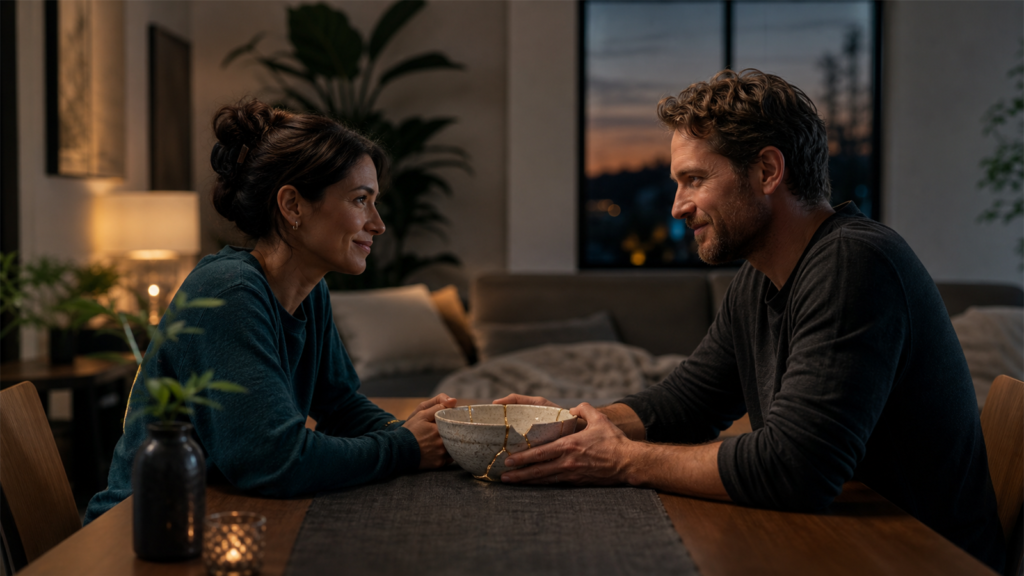
Why You Keep Having the Same Fight With Your Partner
When you keep having the same fight with your partner, it can feel like the relationship is broken. The subject may change, but the pattern feels familiar: one person gets reactive, the other shuts down, resentment builds, and both people walk away feeling misunderstood.
But what if the fight is not really about the dishes, the tone, the schedule, the kids, or the one sentence that set everything off? What if the same argument keeps coming back because neither person has learned how to understand what anger is trying to reveal?
In this episode of Overcome with Travis White, Travis sits down with therapist and anger intelligence expert Davina Hehn to talk about anger, resentment, parenting, communication, emotional regulation, and relationship repair. Davina brings a grounded perspective: anger is not always the enemy. The way we handle it can become the problem.
What we discussed
- Why couples repeat the same painful conflict patterns
- How anger can show up externally or internally
- Why resentment grows when needs stay unnamed
- The difference between controlling anger and understanding it
- How parenting pressure can expose old relationship wounds
- Why repair often starts with self-responsibility
- How anxious attachment can intensify conflict
- Why emotional regulation cannot be outsourced to a partner
- How curiosity and compassion can change the story between two people
Why the same fight keeps coming back
Repeated arguments usually have a surface issue and a deeper pattern. The surface issue might be chores, parenting, money, intimacy, or tone. The deeper pattern is often about safety, control, fear, feeling unseen, or not knowing how to express hurt without turning it into blame.
Davina talks openly about how conflict showed up in her own marriage. Her husband expressed anger outwardly. She expressed it inwardly through shutting down and emotionally punishing. For a long time, the external anger got most of the attention because it was easier to see. But the hidden anger mattered too.
That is a powerful point for couples. Sometimes one person looks like the problem because their anger is louder. The other person may look calm, but they may be carrying resentment, withdrawal, contempt, or fear underneath the surface. Repair gets harder when only one expression of anger is treated as real.
Anger is information, not the whole story
Traditional anger advice often focuses on suppression or control. Calm down. Do not react. Count to ten. Walk away. Those tools can help in the moment, especially when someone might say or do something harmful. But Davina’s anger intelligence framework goes deeper than control.
Anger can be information. It may point to a crossed boundary, an unmet need, fear, grief, exhaustion, shame, or a story you are telling yourself about what your partner meant. The anger itself is not always the deepest truth. It is often the flare that tells you something underneath needs attention.
That does not excuse destructive behavior. Anger never gives someone permission to intimidate, threaten, or hurt another person. But it does invite a more honest question: what is this reaction trying to protect?
Internal anger can damage a relationship too
Some people think they do not have an anger problem because they do not yell. But anger can go underground. It can become silence, sarcasm, emotional distance, passive aggression, scorekeeping, or punishment disguised as self-protection.
That kind of anger can be harder to name because it often looks like withdrawal. The person may say they are fine, but their partner can feel the wall. Over time, that wall becomes its own form of conflict. Nothing gets repaired because nothing gets fully said.
If you keep having the same fight with your partner, it may help to ask how both people express anger. Who gets loud? Who disappears? Who over-explains? Who gets critical? Who tries to force reassurance? Who shuts down to avoid being overwhelmed?
The goal is not to decide who is worse. The goal is to understand the cycle clearly enough to interrupt it.
Parenting, stress, and pressure can expose the pattern
Davina describes how becoming parents placed unexpected pressure on the relationship. That part will feel familiar for many couples. Parenting can reduce sleep, increase responsibility, limit time alone, and bring old fears to the surface. Two people who once felt connected can suddenly feel like they are surviving side by side.
Stress does not create every wound, but it often reveals what was already fragile. If a couple never learned how to repair conflict, parenting may make that gap impossible to ignore. If one partner needs immediate reassurance and the other needs space, the conflict can escalate quickly. If both people are exhausted, even small misunderstandings can feel like proof that they are alone.
This is why relationship repair is not only about communication scripts. It is also about nervous system regulation, sleep, support, honesty, and learning how to pause before the old story takes over.
Repair starts with self-responsibility
Near the end of the episode, Travis asks what Davina would say to someone who is tired of repeating the same arguments and wondering if change is possible. Her answer is direct: it has to start with you.
That does not mean everything is your fault. It does not mean ignoring harm, accepting mistreatment, or taking responsibility for another adult’s behavior. It means your part of the pattern is the part you can actually work with.
Self-responsibility asks questions like:
- What story am I telling myself in this moment?
- What am I trying to control?
- What do I need that I have not clearly named?
- Am I asking my partner to regulate something I need to learn how to hold?
- What behavior would I respect from myself when I look back on this conversation?
That kind of ownership can be uncomfortable, but it is also empowering. If the only answer is that your partner has to change first, you are stuck waiting. If you can see your own moves in the cycle, you have a place to begin.
When anxious attachment intensifies the fight
Davina also names how anxious attachment affected her own conflict pattern. She wanted reassurance in real time. She needed to know they were okay. When her husband needed space, that space felt threatening, so she pushed harder for repair before either person was regulated enough to do it well.
Many couples know this loop. One person moves toward the conflict because disconnection feels unbearable. The other moves away because intensity feels overwhelming. The more one pursues, the more the other withdraws. The more one withdraws, the more the other panics.
Breaking that cycle requires both compassion and boundaries. The partner who needs reassurance may need to practice self-soothing and tolerating temporary uncertainty. The partner who needs space may need to communicate clearly instead of disappearing. Both people need to understand that the goal is not winning the moment. The goal is protecting the relationship while staying honest.
For a related conversation, read Relationship Anxiety Healing: The Secret to Feeling Secure Again. It pairs well with this episode because both conversations explore what happens when fear and attachment shape connection.
Curiosity can change the story
One of the hopeful parts of Davina’s story is that she and her husband learned to rewrite the narrative they had about each other. That matters because repeated conflict is not only about behavior. It is also about interpretation.
If you believe your partner is always attacking you, you will hear even neutral words as a threat. If you believe your partner never cares, every mistake becomes evidence. If you believe you are powerless, every conflict can feel like another trap.
Curiosity interrupts that certainty. It creates space to ask, what else could be true here? What is my partner afraid of? What am I afraid of? What are we protecting? What would this conversation sound like if we believed we were on the same team?
That does not fix everything instantly. But it can soften the posture enough for repair to begin.
When professional support matters
Some couples can make meaningful changes through honest conversations, education, and intentional practice. Others need outside support. If conflict includes intimidation, threats, physical harm, emotional abuse, coercion, addiction, severe mental health symptoms, or fear for safety, professional help is important. In unsafe situations, repair should never be used as pressure to stay in harm.
Even when a relationship is not unsafe, counseling can help couples see patterns they cannot see from inside the argument. A therapist can slow the loop down, name what is happening, and help both people build skills for regulation, repair, and honest communication.
For a broader look at support, read Mental Health Therapy Explained: What It Really Is. Therapy is not a sign that something is wrong with you. It can be a place to understand what is right with you and build from there.
Key takeaways
- The same fight often points to a deeper pattern, not just a surface disagreement.
- Anger can be information about fear, boundaries, needs, grief, or shame.
- Internal anger can show up as shutdown, distance, punishment, or resentment.
- Parenting and stress can expose fragile communication patterns.
- Repair starts with self-responsibility, not blame.
- Anxious attachment can turn temporary distance into panic.
- Curiosity helps couples rewrite the story they have been telling about each other.
- Professional support can help when the loop feels too hard to interrupt alone.
Final thoughts
If you keep having the same fight with your partner, it does not automatically mean the relationship is doomed. It may mean the pattern is asking to be understood. Anger may be pointing to something that needs language. Resentment may be showing you where honesty has been delayed. Shutdown may be telling you the nervous system is overwhelmed.
The work is not easy. It asks for humility, regulation, boundaries, and a willingness to look at your own part without collapsing into shame. But change is possible when both people are willing to stop treating the cycle as the enemy and start learning from what it reveals.
Listen to the full conversation with Davina Hehn for a deeper look at anger intelligence, relationship repair, parenting pressure, and how couples can move from reactivity toward curiosity and compassion.