

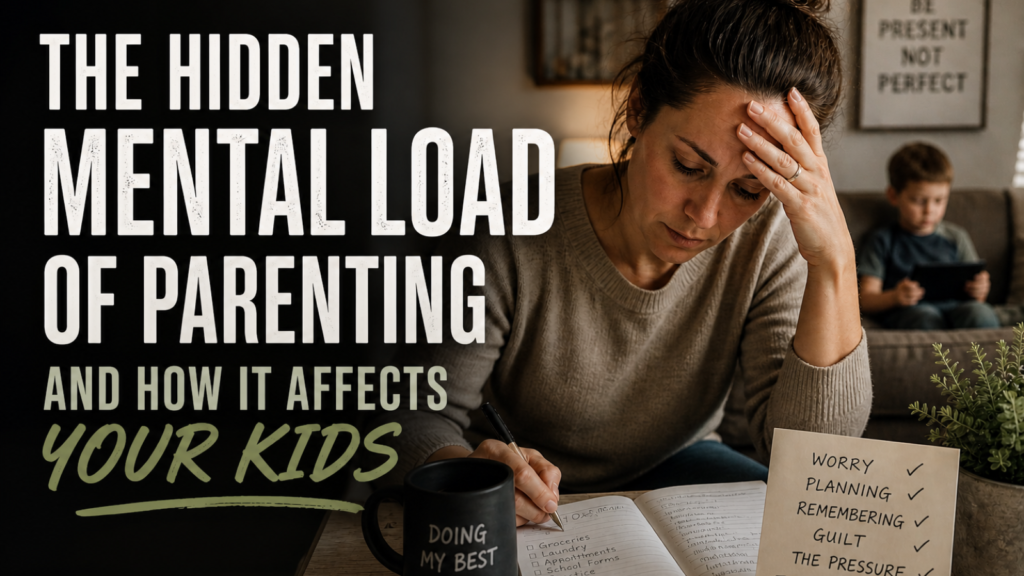
The Hidden Mental Load of Parenting and How It Affects Your Kids
There is a part of parenting nobody really prepares you for. Not the schedules. Not the routines. Not the discipline. I am talking about the weight of it. The worry you carry while you are making dinner. The guilt that shows up after you react too fast. The pressure of trying to be patient when you are exhausted. The quiet question that hits you after a hard moment: Is the way I am feeling affecting my kids?
That is the hidden mental load of parenting. It is the invisible stress parents carry while trying to raise kids, keep a home moving, show up at work, care for relationships, manage emotions, and still somehow be calm when bedtime turns into a battle.
This article is based on an episode of Overcome with Travis White, where Travis opens up about a real parenting moment, what it taught him about his own stress, and why Foundation matters when you are trying to build a healthier home.
Listen to the full podcast episode
What Is the Hidden Mental Load of Parenting?
The hidden mental load of parenting is everything you are carrying that your kids may never see clearly, but often feel anyway.
It is remembering the appointments, watching the clock, managing dinner, tracking school needs, thinking about money, worrying about whether you are doing enough, and trying to regulate yourself when your own patience is already gone. It is the emotional work of being a parent, not just the visible tasks people can point to.
Sometimes the load is loud. You know you are overwhelmed. You feel the frustration rising. You can tell you are one comment away from reacting in a way you will regret.
Other times it is quieter. It looks like tension in your shoulders, a short tone, zoning out, expecting everything to go smoothly, or feeling irritated before anything has actually happened. You may not even notice you are carrying it until one small moment tips everything over.
Why Parents Carry More Than Their Kids Can See
Parents are often trying to hold together more than their children can understand. Kids see the reaction. They do not always see the bills, the exhaustion, the work stress, the marriage stress, the health worries, the mental health struggles, or the fear that you are not doing enough.
In the episode, Travis shares that his wife was pregnant and due any day, and he was feeling like he was taking on a bigger load than usual. He was not using that as an excuse. He was being honest about the reality: mentally, he was already stretched thin.
Then his daughter came home from playing at a friend’s house, and the house shifted into chaos. She was not listening. She was picking fights. She was acting like a six-year-old acts sometimes. But because Travis was already carrying so much, he reacted before he thought. He said things that hurt her feelings.
That moment became the point of the episode. It was not just about his daughter’s behavior. It was about what he brought into the room.
That is hard to admit as a parent. It is easier to say, “My kid is being difficult.” It is harder to ask, “What am I carrying into this moment?” But that question can change everything.
How Your Stress Can Affect Your Kids
Kids may not know the language for anxiety, pressure, resentment, burnout, or emotional overload, but they are watching. They notice tone. They notice facial expressions. They notice when the house feels tense. They notice when you are present and when you are somewhere else in your head.
That does not mean you have to be perfect. No parent is. But it does mean your emotional state matters.
In the episode, Travis talks about realizing that kids can recognize when something is off. If parents do not find a way to correct their own actions and reactions, kids can start copying those patterns too. That is not about blame. It is about awareness.
When you are anxious, your child may become anxious. When you are reactive, your child may become reactive. When you are tense, the whole room can feel tense. And when you slow down, repair, apologize, and reconnect, your kids learn something powerful too.
This is why episodes like Mental Health Therapy Explained matter. Therapy, reflection, support, and honest conversations can help us see patterns we may have missed on our own.
When Parenting Pain Points Go Unnoticed
One of the most useful parts of this conversation is the idea of parenting pain points. These are the moments that set you off the fastest. The places where your patience breaks down. The situations where your expectations and reality collide.
For Travis, one of those moments is bedtime. A lot of parents will understand that immediately. It is the end of the day. Everybody is tired. The kids are tired. You are tired. You want the routine to go smoothly, but suddenly every small thing becomes a struggle.
When those pain points go unnoticed, parents can start living in reaction mode. You are not responding to what is actually happening. You are responding to everything underneath it: the exhaustion, the expectation, the disappointment, the feeling that this should be easier than it is.
Travis shares that in therapy he had to look at expectations. He expected things to go smoother. He expected kids to listen right away. He expected each moment to be easier than it was. But parenting rarely works like that. Kids are still learning. Parents are still learning too.
Lowering expectations in this context does not mean you stop caring. It means you meet the moment for what it actually is. You stop demanding that a tired child behave like a fully regulated adult. You stop demanding that you should feel calm every second. You start telling the truth about the moment in front of you.
Why Foundation Matters in Parenting
Foundation is the F in Travis White’s FAITH Framework. In plain language, Foundation asks:
- What are you standing on?
- What motivates you to keep going?
- What are you struggling with?
That may sound simple, but in parenting it gets very real, very fast.
What are you standing on when your patience is gone? What are you standing on when your kid is melting down and you are already overwhelmed? What are you standing on when you mess up and need to go back into the room, own it, and reconnect?
Foundation is not just a nice idea. It is your baseline. It is what you come back to when things get hard.
Your kids can absolutely be part of your foundation. Travis says his kids and family are a huge part of why he keeps going. They are part of what motivates him to slow down, grow, and become better than he was before.
But there is an important balance here. Kids can be part of a parent’s foundation, but parents still need to notice where they are overwhelmed, stretched thin, or emotionally reactive. If your children are the reason you want to keep going, then part of loving them is being honest about where you are struggling.
A strong foundation does not mean you never crack. It means you know where to return when you do.
What Are You Standing On?
This question can feel uncomfortable because it cuts through the surface.
If you are standing on guilt, you may parent from fear. If you are standing on control, you may struggle when your kids act like kids. If you are standing on old wounds, you may react to moments that are bigger inside you than they look from the outside.
But if you are standing on awareness, honesty, faith, healing, love, and the desire to grow, then even your mistakes can become part of rebuilding. That does not erase the impact of a hard moment, but it gives you a path back.
Travis talks about going back to his daughter after he reacted poorly. He wanted her to know that what he said was not right, that his behavior was unacceptable, and that she still deserved love. That kind of repair matters.
Parents sometimes think repair makes them look weak. It does not. Repair teaches kids that love can come back into the room after conflict. It teaches them that accountability is not shame. It teaches them that people can mess up and still choose connection.
If trust is something you are rebuilding in your own life, Travis’s episode You Can Build Trust for Years… Then Lose It in Seconds connects deeply with this same theme of repair, responsibility, and healing after a painful moment.
How to Start Strengthening Your Foundation
You do not strengthen your foundation by pretending everything is fine. You strengthen it by noticing what is true and choosing one honest next step.
Challenge 1: Ask Yourself the Foundation Questions
Take a moment to ask yourself:
- What am I standing on?
- What motivates me?
- What am I struggling with right now?
Do not rush past the third question. That is often where growth begins. If you know where you are struggling, you can start filling the holes in your foundation. You can ask for help. You can apologize. You can create a reset practice. You can stop acting like the pressure is not there.
Challenge 2: Write Out Your Parenting Pain Points
Sit down and write out your parenting pain points. Identify where stress, pressure, guilt, or emotional exhaustion may be showing up at home.
What moment sets you off the fastest? Where does your patience break down? Is it bedtime? Screens? Sibling conflict? Getting out the door? Noise? Disrespect? Feeling ignored?
Write it down without shaming yourself. The goal is not to beat yourself up. The goal is to see the pattern clearly enough to change it.
Travis also shares a simple grounding tool in the episode: the 5-4-3-2-1 method. Name five things you can see, four things you can feel, three things you can hear, two things you can smell, and one thing you can taste. It can create just enough space to get out of your head and respond instead of react.
For more conversations around grounding and emotional regulation, the episode How to Manage Anxiety and Isolation is another helpful resource.
What We Discussed in This Episode
- The invisible mental load many parents carry
- How stress and emotional pressure can affect kids
- Why parents need to identify their pain points
- How parenting can reveal areas where we need healing
- Why Foundation matters in Travis White’s FAITH Framework
- How to begin rebuilding from awareness instead of guilt
Listen to the Full Episode
If this hit close to home, listen to the full episode of Overcome with Travis White. Travis shares the story behind this article in his own voice, including the real parenting moment, the lesson it brought up, and the practical challenges he gives to parents who want to grow without drowning in guilt.
Listen to the full podcast episode Explore More Overcome Stories
Final Thoughts
The hidden mental load of parenting can make you feel like you are failing, even when you are just tired, stretched, and trying to keep going. But awareness gives you a way forward.
You are not alone because you struggle. You are human. You are not a bad parent because you have hard moments. What matters is whether you are willing to face what you are carrying, repair when you need to, and keep building something stronger.
Your kids are watching, but that does not have to be a sentence of guilt. It can be an invitation. They can see you grow. They can see you apologize. They can see you come back. They can see what it looks like to build a life on a stronger foundation.
Strong families are not built by perfect parents. They are built by parents who keep choosing awareness, repair, love, and growth one moment at a time.