

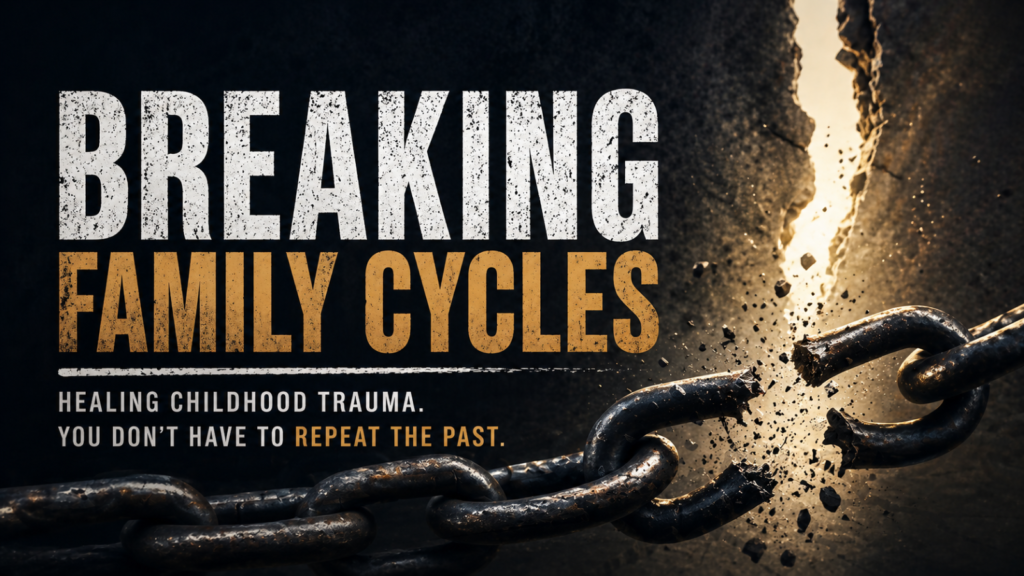
Breaking Family Cycles: How to Heal Childhood Trauma and Dysfunction
You can love your family and still know something has to change. You can understand why people acted the way they did and still admit that their patterns hurt you. You can be grateful for what you survived and still feel tired of carrying the same pain into your relationships, parenting, self-worth, and mental health.
That is the tension at the heart of breaking family cycles. It is not about pretending your past did not happen. It is about finally seeing the pattern clearly enough to stop handing it forward.
In this episode of Overcome with Travis White, Travis sits down with Deborah Moffatt, author, speaker, and host of The Healing Version Podcast. Deborah opens up about growing up with instability, family dysfunction, her mother’s addiction, abandonment wounds, people-pleasing, therapy, journaling, boundaries, and what it means to parent differently after pain.
This conversation is honest without being harsh. It does not turn healing into a slogan. It shows how childhood trauma healing often begins with one uncomfortable truth: the thing you thought was just normal may actually be something you are allowed to outgrow.
What It Means to Break Family Cycles
Breaking family cycles means recognizing the emotional, relational, and behavioral patterns that keep getting passed from one generation to the next, then choosing to respond differently. Those cycles may include addiction, emotional avoidance, yelling, manipulation, secrecy, abuse, neglect, gossip, lack of support, or the belief that family loyalty means tolerating harm.
Generational trauma is pain that does not stay contained in one person’s story. It moves through families when hurt people never get the support, safety, accountability, or language they need to heal. One generation survives by shutting down. The next learns not to talk. Another learns to people-please, explode, disappear, or accept toxic relationships because chaos feels familiar.
Deborah describes a childhood marked by moving often, instability, and a home life shaped by her mother’s addiction. As a child, she did not have the words for what was happening. Later, she began to see the deeper effects: abandonment issues, craving validation, people-pleasing, and wanting to feel wanted somewhere.
That is how family patterns often work. They do not always announce themselves as trauma. Sometimes they look like being the easy child, never asking for much, staying in relationships too long, apologizing for having needs, or feeling responsible for everyone else’s emotions.
Awareness is the first step. Not blame. Not denial. Awareness. You cannot change a pattern you keep calling normal.
How Childhood Trauma Shapes Your Adult Life
Childhood trauma does not always stay in childhood. It can shape the way you trust, love, argue, parent, work, and see yourself. If your early life taught you that stability was temporary, your nervous system may keep scanning for rejection even when life is calmer now.
For some people, healing childhood trauma means learning why conflict feels dangerous. For others, it means understanding why they chase unavailable people, shut down emotionally, over-explain, avoid asking for help, or feel guilty for setting a boundary.
Deborah shared how a relationship triggered something deep in her. When someone pulled away, it touched an old abandonment wound. That pain pushed her into journaling, therapy, and asking a harder question: why did this affect me so deeply?
That question matters. Family dysfunction recovery is not only about what happened to you. It is also about what your body learned to expect because of it. If you were ignored, you may fight to be chosen. If you were criticized, you may assume love has to be earned. If your home was unpredictable, calm may feel strange before it feels safe.
Signs You’re Stuck in a Family Pattern
- You people-please because disappointing others feels unsafe.
- You avoid conflict until resentment builds or you explode.
- You stay in toxic relationships because chaos feels familiar.
- You shut down emotionally instead of saying what you need.
- You struggle to set boundaries with parents, siblings, partners, or friends.
- You repeat parenting or relationship habits you promised you would never repeat.
- You blame yourself for pain that started before you had any control.
These signs are not proof that you are broken. They are clues. They show where old survival strategies may still be running your adult life.
What We Discussed in This Episode
- Deborah’s experience growing up with instability, frequent moves, and family dysfunction
- How her mother’s addiction shaped her early sense of safety and belonging
- Why abandonment wounds can show up later in adult relationships
- How journaling and therapy helped Deborah recognize deeper patterns
- Why people-pleasing often begins as a way to feel wanted or safe
- How becoming a mother changed Deborah’s view of cycles, accountability, and patience
- Why boundaries matter, even when the difficult person is family
- How children can help parents see patterns they still need to change
- Why honest self-reflection is where a healing journey realistically begins
- Deborah’s reminder that every healing journey is individual and cannot be forced into someone else’s timeline
How to Start Breaking the Cycle Today
Breaking a cycle does not mean fixing your whole family. It means taking responsibility for your part of the pattern and refusing to keep feeding what harms you.
- Name the pattern. Be specific. Is it yelling? Silence? Addiction? Enabling? People-pleasing? Emotional distance? Naming it removes some of its power.
- Tell the truth about how it affected you. You do not have to exaggerate or minimize. Honest language is enough.
- Notice where it still shows up. Look at your relationships, parenting, dating, conflict style, boundaries, and self-talk.
- Stop confusing understanding with excusing. You can have compassion for what your parents survived and still decide not to repeat what hurt you.
- Practice one boundary at a time. A boundary may sound like, “I am not available for that conversation,” or, “I need space when this becomes disrespectful.”
- Use support that helps you stay honest. Therapy, journaling, trusted friends, support groups, faith, and healthy mentors can help you see what isolation hides.
- Give yourself room to be imperfect. Deborah talks about grace for a reason. You may stumble. You may get triggered. You may have to apologize and try again. That is still change.
The goal is not to become a flawless person. The goal is to become someone who notices, repairs, and chooses differently more often than before.
You Don’t Have to Repeat the Past
One of the most grounded parts of Deborah’s story is that she does not pretend healing is neat. She talks about anger, grace, therapy, setbacks, parenting, and the daily work of trying not to pass pain to her children. That is real life. Growth is not always dramatic. Sometimes it is catching yourself before you yell. Sometimes it is apologizing. Sometimes it is walking away from a conversation that used to pull you back into dysfunction.
Breaking family cycles also means accepting that some people may not understand your change. Family systems often resist the person who starts naming what everyone else agreed to ignore. That does not mean you are wrong. It may mean you are finally telling the truth.
You do not have to hate your past to rebuild yourself. You do not have to shame your family to choose a healthier future. You can hold compassion and accountability at the same time. You can honor what people survived while still saying, “This stops with me.”
Healing is not about becoming someone who was never hurt. It is about becoming someone who no longer lets the hurt make every decision. The past may explain part of your story, but it does not have to write the ending.
Learn More
Listen to the full episode here: Breaking Family Cycles: Deborah Moffatt on Healing Childhood Trauma and Dysfunction.
- Speaking Your Truth After Childhood Abuse
- Self-Awareness and Resilience with Walter Dusseldorp
- Faith, Resilience, and Healing After Loss
- Explore more Overcome podcast episodes
If this conversation hit close to home, let it be an invitation to pause, not panic. You are allowed to start small. You are allowed to ask for help. You are allowed to become the person who changes what the next generation inherits.