

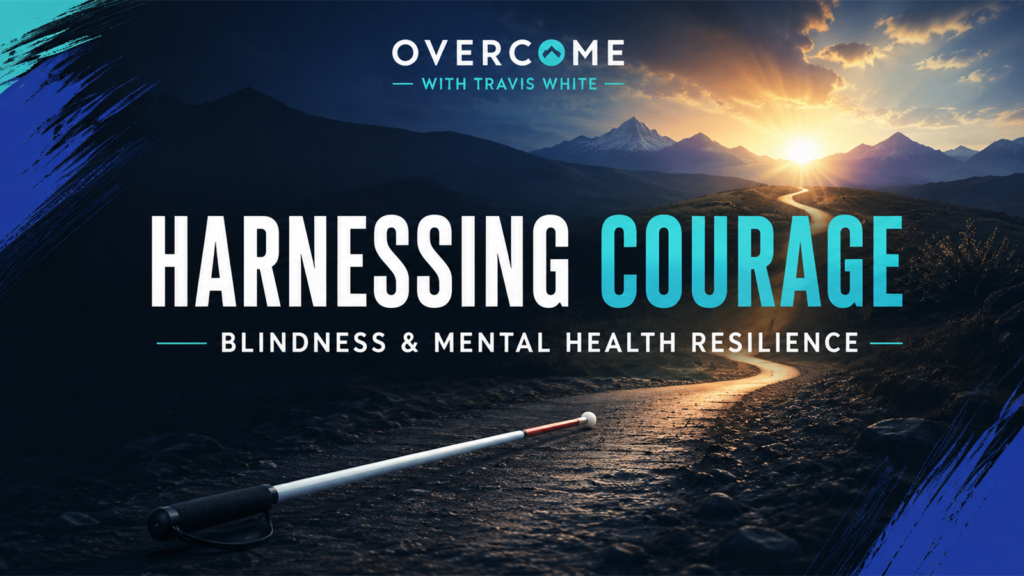
Harnessing Courage: Blindness, Anxiety, and Mental Health Resilience with Laura Bratton
Harnessing courage is not about pretending fear is small. For Laura Bratton, courage began in middle school, sitting in a geography class, when the print on the board suddenly turned into shadowy shapes she could no longer read.
Laura had already been diagnosed with a rare retinal disease, and her family knew she would lose her sight. But that classroom moment made the diagnosis real. What followed was not a simple story of instant bravery. It was denial, panic attacks, anxiety, depression, identity loss, support, counseling, guide dogs, grit, gratitude, and learning how to move forward one moment at a time.
In this episode of Overcome with Travis White, Travis talks with Laura Bratton, author of Harnessing Courage, speaker, coach, and advocate for mental wellness, about blindness and mental health resilience without reducing either one to a motivational slogan.
When Vision Loss Became Real
Laura describes a day in middle school that changed everything. Her teacher asked the class to copy notes from the board. Laura looked up and could not make out letters or numbers. When she asked the student beside her how she was copying the notes, the answer was simple and devastating: the print was normal.
That moment brought her rare retinal diagnosis into daily life. Her vision loss did not happen all at once. It came gradually, with periods where she would lose a significant amount of sight and then adjust until the next change. By the end of high school, she had no usable vision and only some light perception, depending on the conditions around her.
The loss affected more than sight. Laura had loved sports and dance. She had routines, passions, and a sense of who she was. As her vision changed, so did her relationship with school, independence, confidence, and identity. She talks honestly about becoming known as the blind girl, the disabled kid, and the person who felt suddenly different from everyone around her.
Denial, Anxiety, Depression, and the Mindset of I Can’t
Before Laura could name what was happening emotionally, denial became her first response. She told herself it was not that bad, would not last, and could not really be permanent. When denial wore off, anxiety and depression moved in.
Laura connects those feelings to a painful inner phrase: I can’t. I can’t do this. I can’t adjust. I can’t be who I was. I can’t move through this. That mindset did not make her weak. It showed how overwhelming the change felt when she was still a teenager trying to understand a new reality.
She also describes what panic attacks felt like in her body: a heavy tightness in her chest, difficulty breathing, a burning tightness in her throat, and a restless feeling like she was about to come out of her skin. Travis shares his own experience with panic, and the conversation makes space for how frightening it can be when your body feels unsafe even before your mind can explain what is happening.
Support Made Resilience Possible
One of the strongest parts of Laura’s story is that resilience did not arrive through willpower alone. Her parents recognized that she needed help and connected her with counseling. They also helped her keep moving physically, often through simple walks rather than pressure-filled routines.
Just as important, her family kept treating Laura like Laura. Her parents reminded her that they still believed in her. Her brother continued to treat her like his younger sister. That normalcy mattered. It told her through action that blindness had changed her life, but it had not erased her identity.
Laura explains that her parents helped her focus on small, manageable goals. Some days, the goal was simply to get up, get dressed, eat breakfast, and get to school on time. That kind of grit was not about forcing positivity. It was about taking life day by day, moment by moment, and doing the next possible thing.
Why Asking for Help Can Be a Form of Independence
Laura’s story challenges the idea that independence means never needing anyone. As she adjusted to blindness, she had to learn when to ask for help, how to receive support, and how to keep building confidence without pretending she could do everything alone.
That is a helpful reframing for anyone dealing with anxiety, depression, disability, chronic stress, or a life change they did not choose. Support does not make your progress less real. Therapy, medication, family support, movement, mindfulness, nutrition, practical accommodations, and community can all be part of a wider support system. None of them turn healing into a straight line, and none of them should be treated as a universal fix. But the right support can help a person keep going when everything feels too big to carry alone.
If you are dealing with severe depression, suicidal thoughts, self-harm urges, or a mental health crisis, you deserve immediate support from people trained to help. In the United States, the 988 Suicide & Crisis Lifeline is available by calling or texting 988, or through chat on the Lifeline website. If there is immediate danger, call emergency services right away.
Guide Dogs, Emotional Healing, and Rebuilding Confidence
Laura also talks about the role guide dogs played in her life. Their help was not only physical, though physical safety and mobility mattered deeply. Their presence also became part of her emotional healing.
She describes the calm, steady support of her guide dogs and how that presence helped her adjust to a new normal. Travis relates through his own experience of how a dog helped stabilize his anxiety. The conversation is tender because it recognizes something many people with anxiety or trauma understand: sometimes support is not a speech. Sometimes it is presence, routine, safety, and a steady companion when your nervous system is tired.
Grit, Gratitude, and Giving Pain Purpose
Laura’s speaking and coaching work focuses on grit and gratitude, especially for people navigating change, loss, anxiety, depression, and uncertainty. She does not describe gratitude as a way to deny pain. She describes it as a way to anchor attention, notice support, and keep building emotional clarity.
Near the end of the episode, Laura talks about giving pain purpose. That phrase is powerful because it does not erase the pain. It simply names the possibility that painful experiences can become part of how someone supports, teaches, and encourages others.
This is where the episode’s idea of courage becomes practical. Courage can look like acknowledging that you are struggling. It can look like saying you need help. It can look like taking the next five minutes seriously instead of trying to solve the whole future at once.
What We Discussed
- The moment Laura realized her vision loss was changing her daily life
- How a rare retinal disease led to gradual blindness by the end of high school
- Why denial came before anxiety and depression
- What panic attacks felt like physically for Laura
- How counseling, movement, mindfulness, medication, food, and support helped her manage mental health
- The role her parents played in creating small daily goals and steady expectations
- Why guide dogs helped with both safety and emotional healing
- How gratitude journaling became part of Laura’s mental wellness practice
- Why acknowledging struggle can be the first step toward healing
- How Laura now helps others navigate change through speaking, coaching, grit, and gratitude
Learn More About Laura Bratton
Laura Bratton is the author of Harnessing Courage, a speaker, coach, and advocate for mental wellness. Her work helps people navigate change, loss, anxiety, depression, and uncertainty through grit, gratitude, and practical emotional support.
Learn more about Laura, her book, speaking, and coaching at LauraBratton.com.
Listen to the Full Episode
Laura’s story is a grounded reminder that mental health resilience is built through honesty, support, and small moments of courage. If you have ever felt overwhelmed by change, anxiety, depression, disability, or the fear that life will never feel steady again, this conversation offers compassion without pretending the work is easy.
Listen to the Full Episode Explore More Episodes
Overcome With Travis White is a mental health podcast built around real conversations about depression, anxiety, trauma, resilience, faith, identity, disability, and rebuilding life after hard seasons.