

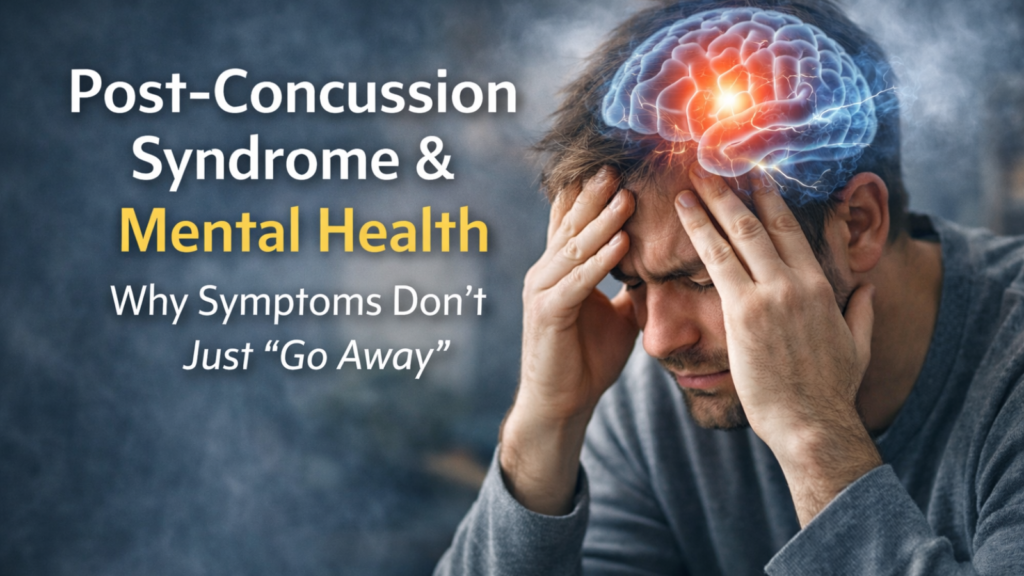
A lot of people assume a concussion is something you either recover from quickly or something doctors can easily confirm with a scan. If your symptoms linger, it can feel confusing, isolating, and honestly a little scary.
That is part of what makes post-concussion syndrome and mental health such an important conversation.
When people are dealing with lingering symptoms after a head injury, they are not just dealing with headaches or brain fog. They may also be fighting anxiety, depression, irritability, apathy, emotional dysregulation, and the discouragement that comes from feeling like something is wrong while being told everything looks normal.
In this episode of Overcome with Travis White, neurological occupational therapist Nate Pope explains why that disconnect happens, why symptoms can persist even when a standard MRI looks normal, and why recovery may still be possible. His perspective is practical, hopeful, and especially meaningful for people who feel stuck after a concussion and do not know what to do next.
When a head injury changes more than your body
For more stories where injury, trauma, and mental health overlap, visit the Trauma Healing hub.
Daniel MacQueen’s story offers another example of mental resilience after a life-changing injury.
One of the most powerful parts of this discussion is how clearly it connects concussion symptoms with emotional and mental health symptoms.
Nate talks about how unresolved symptoms after a concussion can affect nearly every part of life. People may deal with headaches, memory problems, dizziness, blurry vision, word retrieval issues, and brain fog. But that is only part of the picture.
They may also notice anxiety, depression, irritability, apathy, loss of motivation, and feeling much more emotional than usual.
That matters because many people do not realize how deeply a head injury can affect the emotional side of life. They may think they should be over it by now, or wonder why they feel so unlike themselves. They may even start doubting their own experience.
What Nate makes clear is that these emotional changes are not random. They can be part of the post-concussion picture.
Why post-concussion syndrome and mental health are so connected
You can also explore the broader Mental Health hub for related recovery stories.
According to Nate, post-concussion syndrome is what happens when you hit your head and your symptoms do not fully resolve. That is where the mental health side can become especially intense.
When your brain is not functioning the way it normally would, everyday life becomes harder. Thinking clearly can take more effort. Conversations can feel harder to follow. Memory can become less reliable. Sensitivity to noise and light can wear a person down. Sleep can become disrupted. Motivation can drop. Over time, all of that can put real strain on mental health.
It is not hard to see how someone in that position could begin to feel anxious, discouraged, withdrawn, or hopeless.
Nate also points out the severe end of this reality. When quality of life gets low enough and someone cannot see a way out, the consequences can become very serious. That is one reason this conversation feels so important. It gives language to an experience many people may be living through quietly.
Why a normal MRI does not always mean you are fine
One of the most validating parts of the episode is Nate’s explanation of why standard imaging can miss what a person is feeling.
He says that many people hit their head, have lingering symptoms, get an MRI, and are told they are fine. That can be deeply discouraging, especially when they know they are not functioning normally.
His explanation is that the MRI may be right in one sense. The brain tissue itself can still look healthy. But that does not mean the brain is functioning properly.
In his words, the issue can be functional rather than structural.
Certain areas of the brain may not be doing the job they were designed to do. Other areas may start compensating and trying to take over those jobs. That can help a person keep functioning, but it can also create a pattern where the wrong areas are doing the work and the system is no longer operating the way it should.
That distinction matters. It helps explain why someone can have real symptoms without obvious structural damage on a standard MRI. It also helps explain why recovery can still be possible. If the tissue is healthy but the function is off, then the goal becomes helping the brain re-engage in healthier patterns.
Common symptoms people may experience after a concussion
This conversation covers a wide range of symptoms that can show up when someone is dealing with unresolved post-concussion issues.
Some of the symptoms Nate mentions include headaches, brain fog, memory issues, blurry vision, light sensitivity, noise sensitivity, word retrieval problems, dizziness, lightheadedness, balance issues, nausea, mental fatigue, physical fatigue, sleep disruption, anxiety, depression, irritability, apathy, and feeling unusually emotional.
That list matters because many people experience a mix of these symptoms and do not realize they may be connected.
Some may notice that they walk into a room and forget why they are there. Others may find themselves writing everything down because memory feels less reliable. Some may feel exhausted all the time. Others may find that conversations feel harder, noises feel more intense, or emotions feel harder to regulate.
When those symptoms persist for a month or more after a head injury, Nate says that is a major sign that post-concussion syndrome may be part of what is going on.
What concussion mental fatigue can feel like
Concussion mental fatigue is more than ordinary tiredness. Tasks that require concentration, memory, reading, conversation, screen use, or switching between activities may feel unusually draining. The CDC lists feeling tired, slowed down, foggy, and having trouble concentrating or remembering among possible mild traumatic brain injury and concussion symptoms.
Mental fatigue can build as the day goes on or after sustained cognitive effort. Someone may start a task feeling capable, then notice that words become harder to find, focus slips, irritability rises, or a familiar activity suddenly requires much more effort. Fatigue can also overlap with headaches, sleep problems, dizziness, anxiety, depression, light sensitivity, and noise sensitivity, so the pattern can be different for each person.
The Mayo Clinic notes that persistent post-concussive symptoms can include fatigue, poor concentration, memory difficulty, sleep changes, and mood symptoms. If mental fatigue is persistent, worsening, or interfering with work, school, driving, relationships, or basic daily activities, a healthcare professional can help evaluate the full symptom picture. Seek urgent medical care for concussion danger signs such as repeated vomiting, worsening headache, seizures, weakness, slurred speech, increasing confusion, or difficulty waking.
The recovery advice many people hear, and why Nate Pope challenges it
One of the most interesting parts of this discussion is Nate’s challenge to the common advice people often hear after a concussion.
A lot of people have been told some version of this: sit in a dark room, stay quiet, do nothing, and wait.
Nate explains why he believes that approach can become a problem when it turns into total shutdown.
Why total shutdown can backfire
He describes how complete deprivation can reduce visual stimulation, auditory stimulation, verbal engagement, and movement-based input. In other words, a person may end up removing exactly the kinds of stimulation the brain needs in a smaller, more controlled dose.
He also points out something that makes intuitive sense when you hear it. If someone is already vulnerable to anxiety, depression, or emotional difficulty, isolating in a dark room and doing nothing may not help the emotional side of recovery.
That does not mean a person should ignore symptoms or jump right back into a high-stress environment. It means there is a difference between overdoing it and doing nothing.
Why controlled stimulation may help recovery
Nate argues for controlled stimulation rather than full shutdown.
He talks about non-jarring cardio such as a stationary bike or swimming as ways to help get blood to the brain. He also describes the value of walking, talking with someone, being outdoors, and engaging the brain in manageable ways rather than completely withdrawing from life.
He emphasizes that overstimulation can be too much, especially early on. But he also makes the case that complete cocooning is not the answer either. The better path, at least in the way he describes it, is challenge in a smaller, more controlled dose.
He says that doing the right things in those first two to four weeks can drastically reduce the likelihood of prolonged symptoms, and he specifically mentions that this may reduce the odds by about 80 percent.
That is a meaningful shift. It gives people something more hopeful than simply waiting in the dark and hoping it goes away.
What recovery can look like when symptoms do not go away
A major theme in this episode is that lingering symptoms do not always mean permanent damage.
Nate repeatedly comes back to the idea that there is often a path to recovery if people do the right things. He describes therapy as a way of helping re-engage brain areas that have become less active and calm down the areas that have been overcompensating.
He also talks about the importance of intensity and repetition in recovery. In his view, once someone is past that first month and still stuck, the goal is no longer just taking it easy. It becomes helping the brain break unhealthy patterns and build better ones.
He describes whole-brain activities that combine movement, visual challenge, auditory input, and conversation. His larger point is that real life demands multiple systems working together, so recovery should reflect that.
He shares that in his clinic, 95 percent of patients in a one or two week program self-report a 75 percent reduction in symptoms. He also describes an eight week aftercare process built to keep moving people toward the rest of their recovery.
That does not make the process easy. But it does make it hopeful.
Why lingering symptoms can feel so discouraging
This part is worth saying plainly.
When you are told you are fine, but you do not feel fine, it can mess with your head.
It can make you question yourself. It can make you feel isolated. It can make you wonder if this is just your life now. It can make you lose hope.
That is why this conversation matters so much for people struggling with post-concussion syndrome and mental health. It validates the reality that someone can be suffering even if the usual tests do not provide a simple answer.
It also pushes back against the idea that people should just learn to live with it without exploring real recovery options.
Nate’s message is not that every case is simple. It is that people should not settle too quickly for a live with it approach if they have not yet pursued meaningful help.
Practical ideas that came up in this conversation
This episode is not just theoretical. It offers practical direction people can think about.
Based on what Nate discussed, a few takeaways stand out.
- If symptoms are severe right after a head injury, especially repeated vomiting, passing out, or seizures, get immediate medical attention.
- If symptoms continue beyond a month after a concussion, that is a strong sign that more support may be needed.
- Do not assume a normal MRI means your experience is not real.
- Be cautious about total shutdown for too long. Nate argues that controlled stimulation may be more helpful than complete cocooning.
- Non-jarring cardio may be useful as part of recovery, especially activities like stationary biking or swimming.
- Outdoor walking, conversation, and manageable mental engagement may also support recovery.
- If symptoms are lingering, get professional help from someone who understands this area well.
None of that should be taken as a substitute for individual medical care. But it does give people a more hopeful and actionable framework than simply waiting and wondering.
Hope for people struggling with post-concussion syndrome and mental health
The strongest message in this conversation is hope.
Nate is clear that many people who are suffering after a head injury do not have to stay there forever. He believes there is often a real path forward. He has seen people regain quality of life. He has seen symptoms improve. He has seen people recover.
That matters because post-concussion syndrome and mental health struggles can make a person feel trapped in a version of life they did not choose.
If that is where you are right now, this conversation offers something important: the possibility that your symptoms are real, your discouragement makes sense, and your current state does not necessarily have to be the end of the story.
Recovery may take support. It may take the right approach. It may take patience. But this episode makes a compelling case that hope is not naive here.
It is necessary.
If you have been struggling with lingering concussion symptoms, emotional changes after a head injury, or the exhaustion of trying to explain what you are feeling to people who do not understand it, this conversation is worth your time.
You are not making it up. You are not weak. And according to what Nate shared, there may be more hope than you have been led to believe.